
- Kappo Sato Toronto: Ultimate Menu, Prices, Omakase Experience & Guide - September 24, 2026
- Restaurant 20 Victoria: A Complete Guide to Menu, Prices, Ambiance & Reviews - September 24, 2026
- Enigma Yorkville Toronto: Michelin Dining, Menu & Experience - September 23, 2026
Toronto has many excellent Japanese restaurants, but Kappo Sato offers something that even experienced sushi and omakase diners may not have encountered before.
This is not simply a restaurant where a chef places pieces of sushi in front of you one at a time.
Kappo Sato is built around kappo, a traditional Japanese approach in which the chef cooks directly in front of guests using several techniques throughout the meal. Raw fish can appear beside charcoal-grilled food, tempura, broth, Wagyu, hand-cut soba, rice, and tea.
The result is a much broader journey through Japanese cooking.
Located at 575 Mount Pleasant Road in Toronto, Kappo Sato is led by Chef Takeshi Sato. The restaurant serves a seasonal twelve-course experience at an intimate hinoki wood counter. Its official menu currently lists the Kappo Omakase at C$385 per person, with an optional premium sake pairing for C$200.
Kappo Sato also holds one Michelin Star. It received a star in 2023, retained it in 2024 and 2025, and remains listed among Toronto’s one-star Michelin restaurants.
What makes the experience especially interesting is its variety. Instead of focusing almost entirely on nigiri, dinner moves through different ingredients, temperatures, textures, and cooking methods.
For someone who wants to understand Japanese cuisine beyond sushi, Kappo Sato provides a fascinating place to start.
What Is Kappo Sato? A Look at Toronto’s Michelin-Starred Japanese Restaurant
The word “kappo” provides the first clue to understanding this restaurant.
Kappo is a Japanese style of cooking based on seasonality, precision, technique, and direct interaction between chef and guest.
Kappo Sato takes this idea seriously.
The restaurant describes itself as an intimate kappo-style destination offering a twelve-course seasonal tasting experience at one hinoki counter. Ingredients come from Japan, Canada, and other carefully selected sources.
That single-counter format changes the relationship between diner and kitchen.
In many fine-dining restaurants, guests see a finished plate but have little idea what happened before it reached the table. At Kappo Sato, cooking itself becomes part of dinner.
You may see fish being sliced, bonito being shaved, ingredients going onto the grill, tempura emerging from hot oil, or tea being whisked toward the end of the meal.
There is less separation between preparation and presentation.
This also explains why calling Kappo Sato simply an “omakase restaurant” does not tell the whole story.
Omakase means placing your trust in the chef to choose what is served. Kappo describes the broader cooking tradition and interaction taking place across the counter.
At Kappo Sato, the two ideas meet: guests trust Chef Sato with the progression while experiencing the diversity of kappo cuisine.
Where Is Kappo Sato Located? Address & Neighbourhood Guide (Yonge and Eglinton)
Kappo Sato is located at:
575 Mount Pleasant Road
Toronto, Ontario M4S 2M5
The restaurant sits in Toronto’s Mount Pleasant area, east of the Yonge and Eglinton intersection. OpenTable categorizes the neighbourhood as Yonge and Eglinton, while other local guides refer to the immediate area as Mount Pleasant East.
This location gives Kappo Sato a different personality from Japanese fine-dining restaurants concentrated in Yorkville or downtown Toronto.
The surrounding neighbourhood feels more residential and local.
That makes walking through the door somewhat surprising. From the street, you are entering a Midtown Toronto restaurant; once seated at the hinoki counter, the attention shifts quickly toward Japanese ingredients, ceramics, techniques, and rituals.
Visitors using public transit can travel toward the Yonge-Eglinton area and continue east toward Mount Pleasant Road.
Drivers should plan ahead. OpenTable currently lists no dedicated restaurant parking, so nearby street or public parking options may need to be considered.
Because dinner is reservation-only and served at scheduled seatings, aim to arrive early rather than treating the booking as a flexible arrival window.
Meet Chef Takeshi Sato: The Man Behind the Counter
Understanding Chef Takeshi Sato helps explain why this restaurant feels different.
Sato began his culinary career in Tokyo. He moved to Canada in 2011 to serve as the official chef for the Japanese Consulate General in Toronto. His official biography says he has more than two decades of experience in Japanese cuisine.
His expertise also extends beyond cooking.
Sato is a tea ceremony master, sommelier, and international sake master.
Those qualifications make sense when you experience the restaurant.
A kappo meal is not only about knife skills. The chef must understand ingredients, temperature, timing, seasonality, tableware, beverages, hospitality, and the rhythm of the complete dinner.
Tea matters.
Sake matters.
The serving vessel matters.
Even the way an ingredient is introduced to the guest can contribute to the experience.
Sato’s years of training are visible in the diversity of techniques used throughout the meal. A chef specializing entirely in sushi may spend the evening primarily working with rice and raw fish. Here, the job is broader.
One course may require delicate sashimi work. Another needs grilling. The next could involve tempura, dashi, noodles, rice, or tea.
Chef Sato effectively becomes both cook and guide, leading diners through different parts of Japanese culinary culture without requiring them to leave the counter.
What Is “Kappo-Style” Dining? How It Differs from Omakase & Kaiseki
The terms kappo, omakase, and kaiseki are often used together online, but they do not mean exactly the same thing.
Understanding the differences makes Kappo Sato much easier to appreciate.
Omakase literally centres on entrusting the selection to the chef. In Toronto, people commonly associate omakase with sushi counters where the chef chooses a progression of nigiri, sashimi, and related dishes.
Kaiseki is a highly structured multi-course Japanese tradition strongly connected with seasonality, balance, presentation, and a formal progression of dishes.
Kappo sits somewhere different.
The word is associated with cutting and cooking. It emphasizes a chef preparing a broad range of dishes in front of diners at a counter.
Interaction tends to be important.
The cooking can feel more immediate and energetic than a formal kaiseki experience.
Michelin itself makes this distinction when describing Kappo Sato. Its inspectors contrast the restaurant with both the quiet ritual of sushi omakase and the formal structure of kaiseki, describing Chef Sato’s tasting experience as more free-flowing.
A simple comparison looks like this:
| Japanese Dining Style | Main Idea | Typical Experience |
|---|---|---|
| Omakase | Trust the chef | Chef chooses the meal, often sushi-focused |
| Kaiseki | Formal seasonal progression | Structured multi-course Japanese dining |
| Kappo | Cut, cook and interact | Multiple techniques performed near the guest |
| Kappo Sato | Kappo + chef-selected menu | Seasonal twelve-course counter experience |
The difference becomes obvious once the food starts arriving.
At Kappo Sato, you are not waiting for twelve variations of sushi.
One course might be sashimi. Another may be grilled over charcoal. Tempura can follow. Dashi may form the foundation of another dish. Rice cooked in a traditional pot can appear later.
That variety is the point.
Kappo Sato Hours of Operation & Seating Times
Kappo Sato is currently open for dinner Wednesday through Saturday and closed Sunday through Tuesday.
Current published operating hours are:
| Day | Hours |
|---|---|
| Monday | Closed |
| Tuesday | Closed |
| Wednesday | 5:30 PM – 11:30 PM |
| Thursday | 5:30 PM – 11:30 PM |
| Friday | 5:30 PM – 11:30 PM |
| Saturday | 5:30 PM – 11:30 PM |
| Sunday | Closed |
OpenTable and current local listings show these Wednesday-to-Saturday hours.
However, the official restaurant site gives the more important detail: dinner operates with two seatings each evening and is available by reservation only. The restaurant advises guests to consult its booking platform for the current service times because policies and schedules can change.
That distinction matters.
Do not assume you can arrive at 8:15 p.m. simply because the restaurant is technically open until 11:30 p.m.
Your reservation determines when your experience begins.
Menu with Prices
Kappo Sato currently offers a twelve-course Kappo Omakase rather than a large à la carte menu.
The official 2026 price is C$385 per guest.
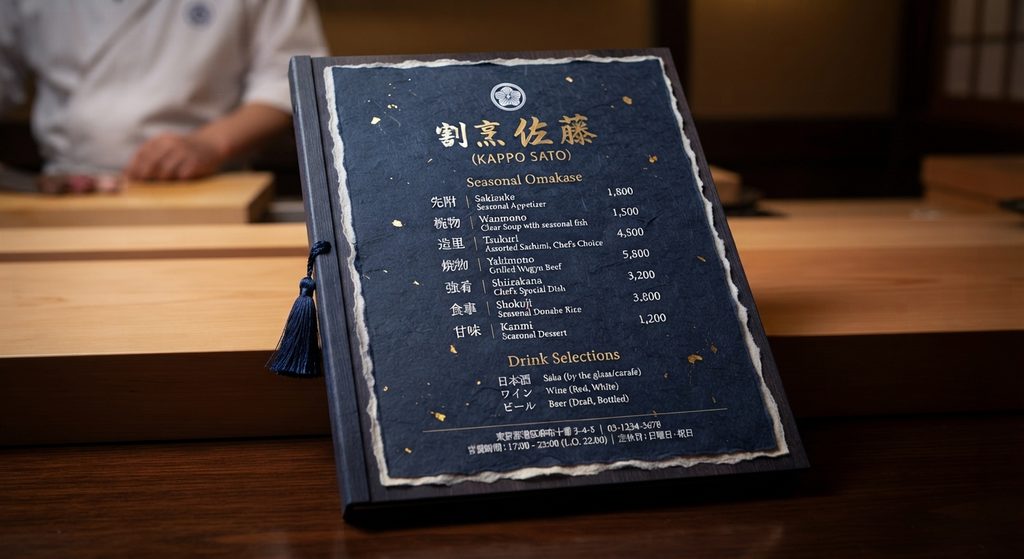
A premium sake pairing curated by the restaurant’s sake master and sommelier is available for an additional C$200. The restaurant also states that ingredient availability, order, and even the exact number of courses can vary according to the season.
| Menu / Course | What You Can Expect | Current Price |
|---|---|---|
| Kappo Omakase | Seasonal chef-selected dining experience | C$385 |
| Premium Sake Pairing | Curated sake pairing | C$200 |
| Chawanmushi | Savoury Japanese egg custard | Included |
| Sashimi | Seasonal premium fish | Included |
| Sushi / Nigiri | Seasonal chef-selected seafood | Included |
| Grilled Course | Seasonal ingredients prepared with heat/charcoal | Included |
| Tempura | Delicately fried seasonal ingredient | Included |
| Wagyu Course | Premium Japanese-style beef preparation | Included |
| Dashi-Based Course | Broth made using premium Japanese ingredients | Included |
| Rice Course | Rice prepared in a copper Hagama pot | Included |
| Tea | Traditional matcha/tea experience | Included in progression |
| Dessert | Seasonal Japanese-inspired sweets | Included |
The restaurant adds a 20% gratuity to the bill.
For a couple ordering two C$385 menus, the food alone is C$770 before applicable taxes and other charges. Adding two C$200 sake pairings brings the menu-and-pairing subtotal to C$1,170 before tax and the restaurant’s stated gratuity.
That makes Kappo Sato a serious special-occasion expense.
But price comparisons with ordinary sushi restaurants are not particularly useful. The experience involves roughly a dozen preparations, expensive ingredients, a very small counter, significant chef interaction, and cooking techniques that extend far beyond sushi.
Inside the Kappo Omakase Experience: What to Expect Course by Course
The best part of Kappo Sato is that dinner does not stay in one culinary lane.
The official menu promises twelve dishes incorporating Wagyu, sushi, sashimi, grilled preparations, tempura, and rice cooked in a copper Hagama pot.
A 2026 professional review provides an even clearer picture.
The Infatuation describes an eight-seat counter experience beginning with chawanmushi before moving through sashimi, tempura, grilled elements, noodles, seafood rice, matcha, and dessert.
The opening
Dinner may begin gently.
Chawanmushi is a Japanese savoury egg custard known for its exceptionally soft texture. It prepares the palate without overwhelming it.
Raw seafood
Sashimi allows the quality of the fish to become the focus.
A recent menu described by The Infatuation included uni wrapped with kombu-cured hirame, demonstrating how even a raw course can involve careful preparation beyond simply slicing fish.
Dashi
One of the most revealing moments may involve something that looks deceptively simple: broth.
Kappo Sato calls dashi the heart of Japanese cuisine.
Its version uses Hokkaido kombu and dried bonito from Kagoshima, with bonito shaved fresh in front of diners.
This is important because dashi forms the flavour foundation of countless Japanese dishes.
Watching it being created makes an ingredient usually hidden in the kitchen visible.
Tempura
Good tempura should not feel greasy or heavy.
The Infatuation recently highlighted shiso-wrapped anago tempura cooked in a custom pot, describing the batter as notably light.
Sushi
Sushi appears as one chapter rather than the entire story.
Michelin has previously highlighted seared toro nigiri with Japanese green onions among Chef Sato’s creations.
Grilled dishes
Heat introduces another dimension.
Charcoal can produce aromas and textures impossible to achieve through raw preparation. The movement from sashimi to grilling also prevents the meal from becoming repetitive.
Rice
Rice becomes a serious course rather than an afterthought.
The restaurant uses a copper Hagama pot, and seafood can be incorporated into the finished preparation.
Tea and sweets
Toward the end, the pace changes again.
The Infatuation describes ceremonial matcha whisked immediately before serving, followed by simple desserts.
It creates a calm ending after a technically varied meal.
Signature Dishes & Ingredients Flown in from Japan
Seasonality makes the phrase “signature dish” slightly misleading at Kappo Sato.
The restaurant is not built around one permanent plate.
Its signature is really the combination of ingredients and techniques.
Michelin has specifically noted that many ingredients are flown in from Japan.
The official restaurant information adds that sourcing also extends to Canada and other regions, allowing the chef to select ingredients according to quality and season rather than nationality alone.
Several Japanese ingredients are especially important.
Hokkaido kombu is used for dashi. Kagoshima dried bonito is shaved fresh. Premium fish can arrive according to season and availability.
Uni, toro, hirame, anago, and Wagyu may appear depending on the menu.
But expensive ingredients alone do not explain the appeal.
Consider bonito flakes.
A diner could easily overlook them as a basic pantry ingredient. At Kappo Sato, watching a block of dried bonito shaved into paper-thin curls before it contributes to a broth turns an everyday foundation of Japanese cuisine into part of the experience.
That transformation—from ingredient to technique to finished flavour—is at the heart of kappo cooking.
How to Make a Reservation at Kappo Sato
Kappo Sato is reservation-only.
The restaurant accepts online reservations for parties of two or more through its booking system. Single diners, groups of five or more, and guests requiring special arrangements are asked to contact the restaurant directly.
The reservation process is more personal than simply clicking a time slot.
According to Kappo Sato’s current policy, the team contacts guests by phone three days before the reservation. During that conversation, staff confirm celebrations and ask about dietary restrictions or preferences.
Take this call seriously.
A twelve-course Japanese menu can contain raw seafood, shellfish, soy, fish broth, Wagyu, eggs, and other ingredients that may be difficult to substitute without advance notice.
If someone in your party has an allergy, explain it clearly.
There is evidence that the restaurant takes such details seriously. A July 2026 OpenTable reviewer reported that the restaurant adjusted the menu for a shrimp allergy and even prepared individually printed menus reflecting the change.
The restaurant currently accepts reservations for two nightly seatings, so punctuality is essential.
Dress Code, Ambiance & Dining Etiquette
OpenTable currently describes the dress code as dressy.
You do not necessarily need a tuxedo or formal evening gown, but smart, polished clothing is appropriate for the setting and price level.
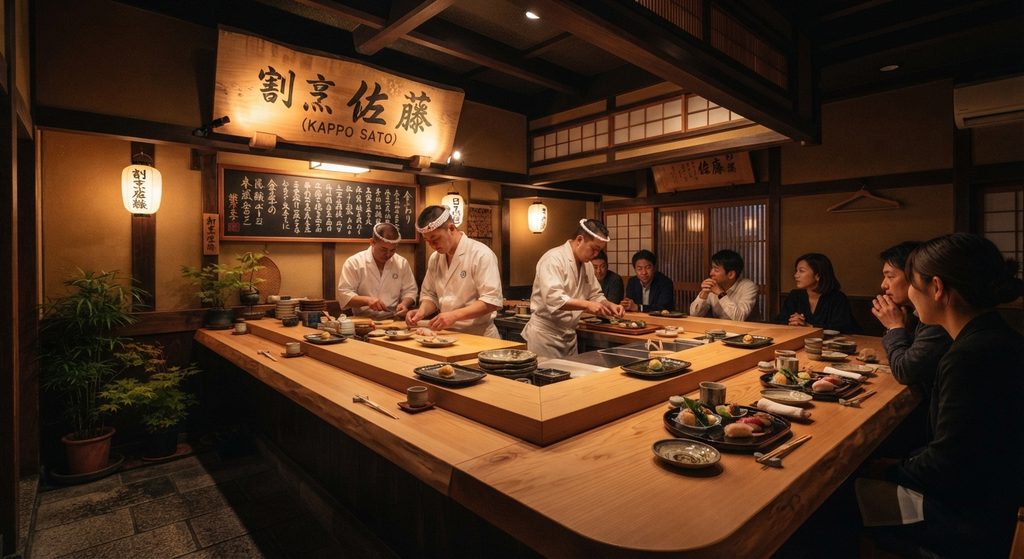
The atmosphere revolves around the counter.
With only a small number of diners facing the open kitchen, everything feels closer than it would in a conventional dining room.
You see the chef.
The chef sees you.
That creates an opportunity for interaction, but it also means basic counter etiquette matters.
Arrive on time. Avoid wearing overpowering perfume or cologne because strong fragrances can interfere with subtle aromas from dashi, fish, sake, and tea.
Photography should be discreet and should not delay eating a dish that the chef intends to be consumed immediately.
When a course arrives, listen to the explanation before reaching for condiments. A carefully seasoned dish usually does not require extra soy sauce or wasabi unless the chef suggests it.
Questions, however, can improve the experience.
Ask about an unfamiliar fish.
Ask where an ingredient came from.
Ask why a certain ceramic vessel was chosen.
Kappo dining encourages a closer relationship between guest and chef, so curiosity fits naturally into the evening.
Michelin Star Recognition: Why Kappo Sato Stands Out (2023–2025)
Kappo Sato’s Michelin story began shortly after Toronto received its own Michelin Guide.
The restaurant appeared among Michelin’s new Toronto additions in August 2023. Michelin’s description emphasized that the experience differed from both conventional sushi omakase and formal kaiseki, praising Chef Sato’s control, knife skills, Japanese ingredients, dashi, tempura, and toro nigiri.
Kappo Sato received one Michelin Star in 2023.
It retained that distinction in 2024 and again in 2025. OpenTable’s current award information records Michelin one-star recognition for all three years.
The official 2025 Michelin Toronto list likewise includes Kappo Sato among the city’s one-star restaurants.
Why does that matter?
Not because a star automatically means every diner will prefer it to every other Japanese restaurant.
The significance lies in what Michelin recognizes: cooking quality and consistency at a high level.
Kappo Sato also stands out because kappo is still much less familiar to Canadian diners than sushi or ramen.
Toronto has several serious omakase counters. Kappo Sato introduces guests to a broader expression of Japanese cooking where knife work is only one part of the chef’s skill.
Fire, broth, frying, rice, noodles, tea, and hospitality all have a role.
Customers Reviews & Ratings
Customer feedback helps reveal something Michelin cannot: how ordinary paying diners feel after spending several hours at the counter.
Recent ratings are strong.
Restaurantji currently reports a 4.6 out of 5 rating from 72 ratings, while another restaurant aggregation service lists a Google rating around 4.7 out of 5 from more than 100 reviews.
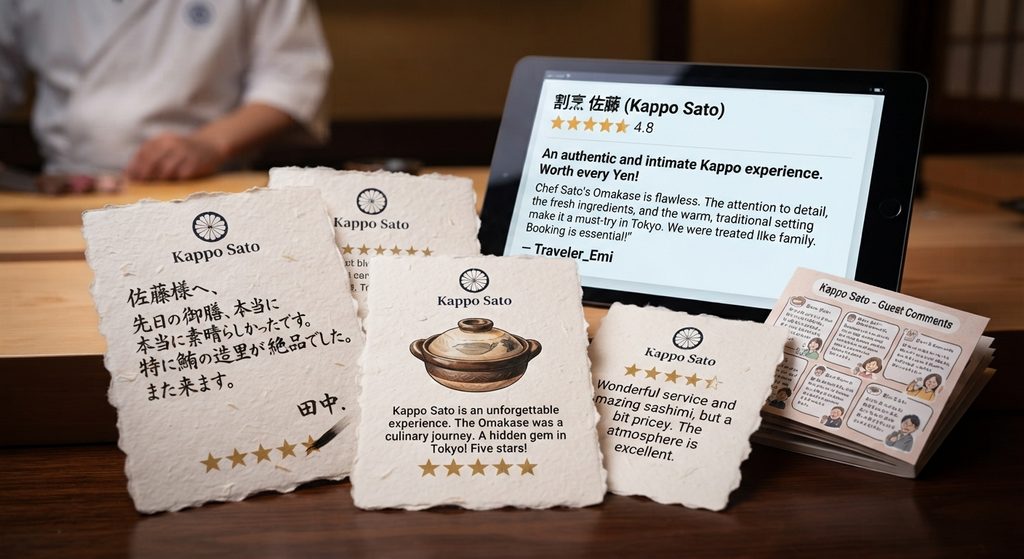
The themes in positive reviews are particularly consistent.
Guests frequently mention variety.
One 2025 reviewer praised the mixture of textures, flavours, and cooking styles, specifically noting grilled, raw, broiled, tempura, and rice preparations.
That is exactly what differentiates kappo from a sushi-only experience.
Recent OpenTable reviews from July and August 2026 also praise the service, plating, attention to detail, and progression of the twelve courses. One diner described the range as moving through appetizers, soup, sushi, sashimi, meat, rice, and shaved ice.
Another recurring theme is seasonality.
Guests understand that returning later can produce a different meal rather than an exact repeat of the first experience.
Not every opinion is perfect, of course. One recent customer described the restaurant positively while still saying it was not their favourite Japanese restaurant in Toronto.
That is useful context.
At C$385 before pairing, tax, and gratuity, expectations will naturally be extremely high. Personal preferences about sushi, portion size, formality, value, and pacing can strongly influence a review.
The best way to judge the feedback is therefore to ask whether reviewers praise the things that matter to you.
If variety, craftsmanship, Japanese tradition, ingredient quality, and counter interaction are priorities, the feedback is especially encouraging.
FAQs
1. How much is Kappo Sato in Toronto?
The official Kappo Omakase currently costs C$385 per person. The optional premium sake pairing costs an additional C$200. A 20% gratuity is added to the bill, and the restaurant notes that prices and policies can change.
2. Does Kappo Sato have a Michelin Star?
Yes. Kappo Sato received one Michelin Star in 2023 and retained one-star recognition in 2024 and 2025. Michelin continues to list it among Toronto’s one-star Japanese restaurants.
3. How many courses does Kappo Sato serve?
The restaurant currently advertises a twelve-course seasonal Kappo Omakase. The exact number, ingredients, and order can vary depending on the season and ingredient availability.
4. Is Kappo Sato the same as a sushi omakase restaurant?
Not exactly. Sushi and sashimi are part of the meal, but kappo uses a much wider range of Japanese cooking techniques. Guests may experience tempura, grilled food, Wagyu, dashi, noodles, rice, tea, and desserts in addition to raw seafood.
5. Can one person book Kappo Sato?
Yes, but the standard online reservation system is designed for parties of two or more. Single diners are asked to contact the restaurant directly to arrange a reservation.
Conclusion
Kappo Sato offers a side of Japanese cuisine that many Toronto diners rarely experience.
Its appeal is not simply that it serves premium fish or has a Michelin Star.
The restaurant becomes interesting when you watch Japanese culinary techniques connect across an entire evening.
A piece of fish may be sliced with extraordinary precision. Bonito is shaved to create dashi. Another ingredient meets charcoal. Tempura emerges crisp and delicate. Rice cooks in a copper Hagama pot. Sake changes how a course tastes. Matcha brings the experience toward its close.
Behind that progression is Chef Takeshi Sato, whose background combines more than two decades of Japanese cooking with knowledge of tea ceremony, sake, wine, and formal hospitality.
The experience is undeniably expensive.
At C$385 for the Kappo Omakase and C$200 for the optional premium sake pairing, this is positioned as a major dining occasion rather than a casual Japanese dinner.
But diners are receiving something very different from a standard restaurant meal.
There are only a small number of seats. The kitchen is directly in front of you. Ingredients change with the seasons. The chef moves between raw preparation, broth, frying, grilling, rice, and tea rather than repeating a single technique.
That diversity is the strongest reason to consider Kappo Sato.
Choose it if you want to understand Japanese cuisine beyond sushi and are interested in watching craftsmanship happen directly across the counter.
Book well ahead, arrive on time, communicate dietary restrictions during the restaurant’s confirmation process, dress appropriately, and approach the menu without trying to predict every course.
The most rewarding way to experience kappo is exactly as the format intends: sit at the counter, trust the chef, watch closely, and allow each season to determine what comes next.